Showing posts with label birds. Show all posts

Thursday, July 19, 2012

Out ridin' fences

4:30a: an early morning thunderstorm (alarm clock reset, sleep gratefully resumed)
(obviously this isn't a photo of a thunderstorm at 4:30a, but of an afternoon one last week)


7:18a: pack cooler full of cold water and Gatorade

7:23a: load truck and leave for Prairie Chicken telemetry

7:44a: see first Common Nighthawk of the day


7:48a: stop for a minute to watch baby bison


7:54a: hop out of the truck while Clint Black's Desperado starts to play on the radio

7:57a: record first triangulation point for today's Prairie Chicken #1


8:00a: glad to be back at work in the field in Kansas

11:45a: run ATV through a too-fresh pile of cow dung and get a bit splattered

11:46a: reassess

11:47a: still glad to be back at work in the field in Kansas

Sunday, September 25, 2011

Birds: Part III

More birds on this Sunday morning.  Let the theme be... sparrows!

Near and dear to my heart more than any other group of birds.  I'm firmly in their corner when it comes to defending them against people who think of them only as "Little Brown Jobs."  Sacrilegious, I say. 


This is a Nelson's Sparrow. She's a female that my mosquito-bitten field helper and I stumbled upon while we were looking and listening for males to try to target net in wet, marshy meadows at the mouth of the Moose River in northern Ontario.  She must have had a nest nearby because she was unhappy that we were near and tried to distract us and lure us away from her nest by flitting around from one side of us to another.  

We set up the mist net, and after some strategic chasing, we captured, banded and sampled her.  This photo was snapped before she was captured.  It drove poor Randy crazy that I was taking pictures before we'd captured her, but I really had no doubt that she would not fly away - she wouldn't leave her nest.  And it is a very rare thing to be so close to these birds when they're out in the open.  I couldn't miss the chance to get a shot.

Her stats (for anyone even slightly interested): blood mercury = 0.32 ppm; breast feather mercury = 0.61 ppm; first primary feather mercury = 6.74 ppm.  She weighed 15.5 grams, and her bill was 9.0 mm from nares (nostril) to tip.  For the sake of reference, the U.S. EPA prefers that women of child-bearing age having blood mercury levels lower than 0.006 ppm.  If you do the math, this lady sparrow had a blood mercury concentration over 50 times as high as what the EPA would recommend if she were human. Scary thought.   


These are Seaside Sparrows - close cousins to the Nelson's Sparrow above.  These guys (I don't really know if they're guys, but if you can't tell one way or the other, every sparrow gets called a guy) were captured during the non-breeding season near Wrightsville Beach, NC.  


Saltmarsh (left) and Nelson's Sparrows captured during the non-breeding season in NC.  Saltmarsh Sparrows are close relatives to both Seasides and Nelson's.  They all belong in the same genus.  Still think these guys are Little Brown Jobs?  


Another sparrow relative - the Savannah Sparrow.  Savannahs are found in a different genus from the marshy sparrows above.  I caught them sometimes in the marshes along with Nelson's, Saltmarsh and Seaside Sparrows, but I just photographed them and let them go.  No poking and prodding for them.  


These two are White-crowned Sparrows - male (above) and female.  They belong to yet another sparrow genus and were photographed in New Mexico.  

Unlike the colorful birds I posted about last time I was writing about birds (for fun), sparrows have a different specialty.  Subtlety.   And for that, I give them kudos.   


Sunday, August 14, 2011

Birds: Part II

Back to the business of posting some bird photos again. Today's theme is birds of various colors. I'm limiting these to friends we can see right here in North America. I'll leave their perhaps more obvious counterparts from the Tropics alone for the time being.

This is a Summer Tanager, a member of the Cardinalidae family and a specialist on capturing and eating bees and wasps. All red.

This fellow is a Blue Grosbeak, also of Cardinalidae. He's obviously wondering who that strikingly handsome bird in the water is and whether he poses any threat.

This is a Prothonotary Warbler. Named for clerks in the Catholic Church who wore bright golden robes. (Other birds named for Catholic officials: Northern Cardinal, Orange Bishop.)

Tundra swans in an (apparently) empty cornfield on NWR land in mid-winter. They've been out feeding all day and are about to go huddle together on or near a nearby lake to keep safe and warm on this winter night.

American Bittern. Hard to spot, huh? That's not an accident. He's hiding and doing a pretty good job of it.

Tuesday, July 19, 2011

Birds: Part I

Once upon a time when I was an undergraduate at Benedictine College, I did some research involving bird biodiversity on a mitigated Missouri River wetland site.

Then I switched to researching Prozac in fish (everyone always giggles when I say this, but it's the truth) for my Master's degree. Birds got left behind.

Then, being unfulfilled academically with the world of fish research, I opted to gear my life back in the avian direction when it was time for a new degree.

This time around, being scientist performing bird research instigated a new hobby. Birding. Not birdwatching, mind you. But birding. There's a difference. Ask any birder - he or she will tell you.

So in hopes of sharing some of the fruits of this hobby, my plan is to write a few posts with some photos of (what I think are) interesting birds. Some of these species are easy to find, others not so much. But in every case, I'm pretty sure that the photos don't actually do the birds justice.

It's hard enough to take photos of birds anyway - they can move in three dimensions you know. I am only accustomed to moving in two. And without a telephoto lens, I have to be sneaky to get as close as I do most times.

Anyway, the birdy posts shall commence with... shorebirds!

A breeding (or at least the male is hopeful that this is/will be so) pair of Least Terns. He is offering her a small fish in return for her affections. She is slighting him by aiming her tail feathers in the direction of his stinky fish. I'm not hungry right now, thank you. He followed her around, wagging this fish at her for a good while. He never tired of the exercise, and she never tired of showing him her backside. I, however, did tire of the escapade and moved on with my life without waiting to see how it turned out.
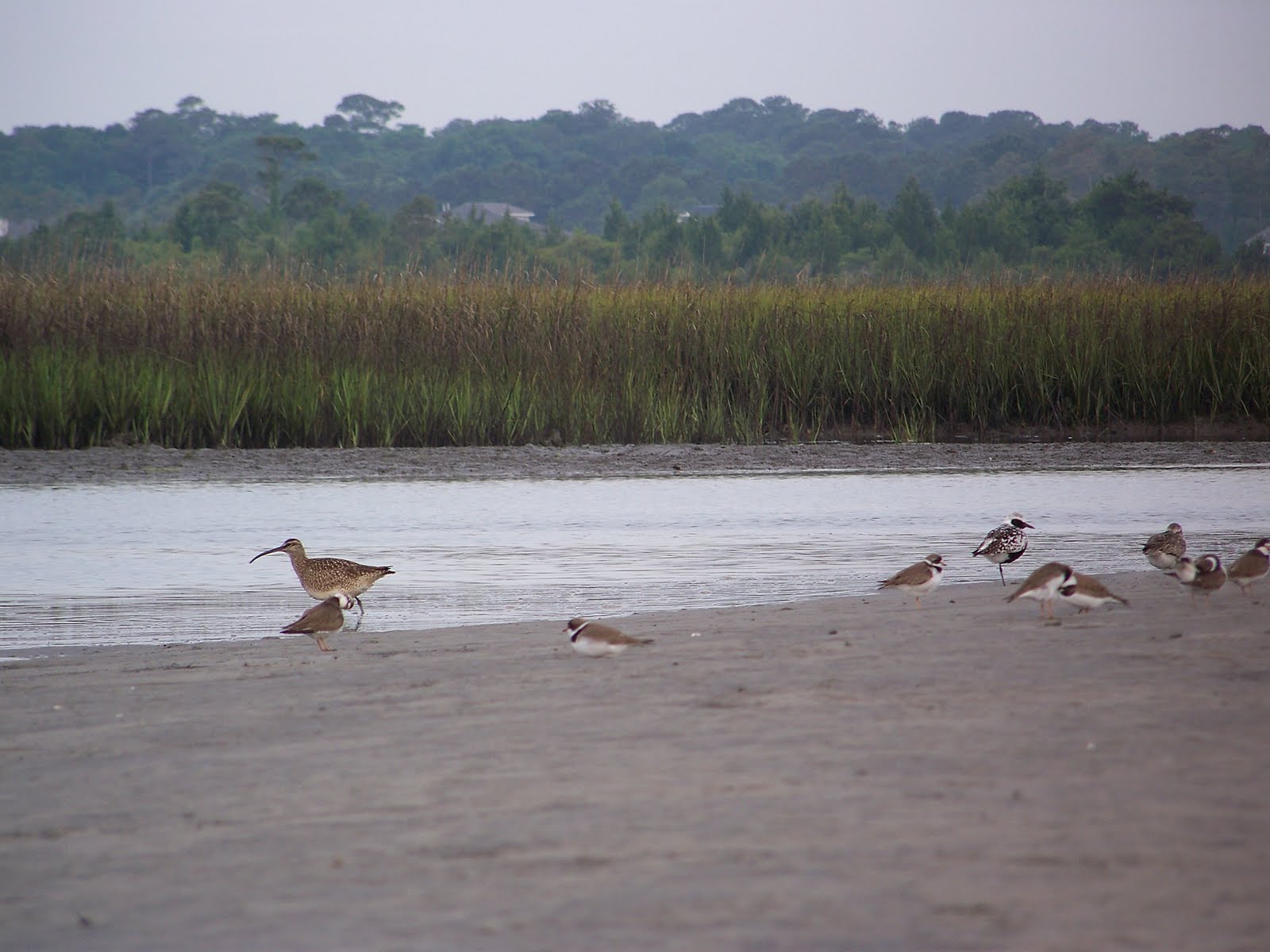
Here we have a Whimbrel (on left with down-curved bill) and a Black-bellied Plover (toward the right (with black belly)) and some Semipalmated Plovers mixed in. Shorebirds are fun/frustrating because you never really know what you might be able to pick out in a mixed flock of migrants. Almost anything could be lurking in there. Somebody's always leaving the flock, and someone else is always flying in, but it's the birder's job to keep track of them all while scanning the whole flock to make sure that there are no Purple Sandpipers where there aren't normally Purple Sandpipers. A spotting scope (though I hate to admit it) can help.

Here is one of the oddest-looking birds I can think of. Orange eyes, red bill and pink legs make this an American Oystercatcher. And yes, this one is wading amongst the oysters in this oyster bed, going about his work of... catching oysters. In true life he is probably just looking for little crabs and insects in there. But they do eat oysters too.

Here is one of a Dunlin in the spring, still working on his black belly patch for to impress the lady Dunlin in the summer. Though you can't really see it here, this species is characterized by a slightly drooping bill. I may, on my bravest of days, dare to refer to it as cute. It's as if someone took a normal shorebird bill and grabbed it by the end and bent it downward ever so slightly.

And this bird... oh this is one of my favorites. A Marbled Godwit. This guy has the opposite bill situation from the Dunlin above in that his long, skinny bill is slightly upcurved. And oh so delicate.

Now boys and girls, don't try this at home, but I walked through multiple oyster beds at low tide in flip-flops to take a picture of that bird. That is the extent to which my admiration for this species will take me (well, I'd probably do something crazier, but I didn't have a need to this time).

What was I doing in the salt marsh at low tide wearing flip-flops you might ask? Well, kayaking of course. The thing about turning into a birder is that in the beginning, you might forget that you're a birder (and that birders never stop birding) and then go do something like get in a kayak wearing flip-flops at low tide. But then being unable keep from birding, it becomes necessary to exit the vessel and pursue your quarry on (flip-flopped) foot.

The end result was the photo above and a left big toe with a large slice on the side. A slice that has left a scar. A scar that I think of in my head as my Godwit scar.

Tuesday, June 21, 2011

When one in the hand does not equal two in the bush

Many apologies for my absence. There are good reasons for it, I promise. They have to do with all of my worldly goods being purposely carted 1,300 miles and the upheaval that that entails. Maybe I should post about that in the future.

My current reason for being post-less for so long is that I'm in the middle of a sparrowing trip in Grand Forks, ND. It entails getting up freakishly early in the morning and walking through wet, muddy, fragrant meadows with an iPod, a speaker, a net and a few other accouterments (weighing in total approximately 48 pounds).

Freakishly early in the morning.

And again (and every day).

The current total is up to 17 sparrows of the intended variety (Nelson's Sparrow). Today was a banner day in terms of biodiversity (n = 5). Not-so-much in terms of adding to the total for sparrows of the intended variety (n = 1).

But I suppose when you're not catching Nelson's Sparrows, you might as well be catching something else - just to pass the time. I often think, upon seeing a bird, that I would appreciate being able to hold it in my hands to examine it more closely. Today I got that chance, though I didn't particularly want it at the time.

We inadvertently captured five times more 'other birds' than Nelson's Sparrows today. Then we ate pancakes and took a nap.

The 'other birds' in no particular order...


(I cheated and used an old photo here - ND Savannah Sparrow wasn't lucky enough to be photographed this time. Truth be told, I just dumped him unceremoniously out of the net and let him go his merry little way. I was grumpy because he wasn't one of his cousins.)


and last but not least, Swamp Sparrow

On a sunnier (literally and metaphorically speaking) day, we did catch some lovely numbers of the 'right birds.' This is a Nelson's Sparrow friend I banded in ND two summers ago and ran into again this week. He was absent from my capture list last summer, but my bet is that he was here.

Anyway, the moral of the story is that the old adage of one bird in the hand is worth two in the bush is not necessarily always applicable. And in this case, it makes this being a bit grumpy.

So...

Dear 'other birds,' I do love you for who you are, but please tell your friends the Nelson's Sparrows that I require their presence... sooner rather than later.

Not pictured (but seen or heard): Clay-colored Sparrow, Grasshopper Sparrow, Song Sparrow, Bobolink, Wilson's Phalarope, Red-winged Blackbird, Northern Harrier, White Pelican, Western Meadowlark, Eastern Kingbird, Cliff Swallow, Sedge Wren